

Intake
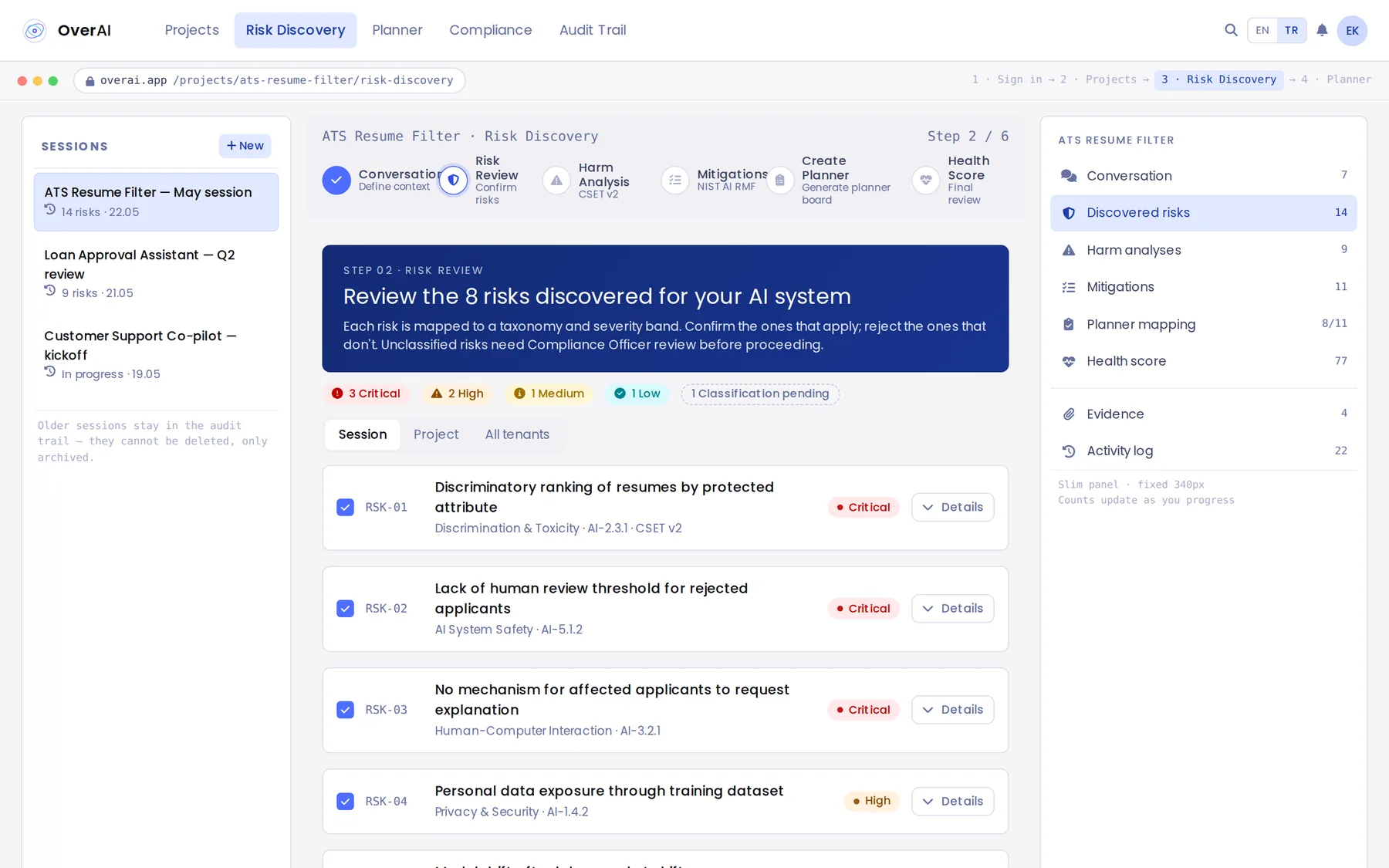
The AI system is clarified through conversation with the Risk Agent, or built automatically from your project documentation.
Observability · Verification · Explainability · Risk assurance
Turn AI from a possible unmanaged liability into a managed, auditable asset.
Grounded in
AI adoption is racing ahead of risk and governance. These are the six places teams get stuck, and every one of them is a question an auditor will ask.
Which AI systems carry which risks is unknown across the organization.
The documents auditors want are built by hand, scattered, and re-done each time.
Mapping many frameworks at once, from the EU AI Act to ISO 42001 and GDPR, is hard.
Risks fall between departments, and actions are not tracked to completion.
With limited resources, which risk to tackle first is not obvious.
Assessments are tied to a single AI vendor and are not portable.
Auditors and regulators now demand evidence for AI and its risks. Recent milestones make compliance non-optional, especially in the EU.
Feb 2025
EU AI Act: prohibited practices and AI literacy in force
Aug 2025
Obligations for general-purpose AI (GPAI) models
Aug 2026
Transparency duties for generative AI, plus market surveillance
2026 to 2028
Phased compliance timeline for high-risk AI systems
The world's first extensive law related to AI. The Digital Omnibus package proposes amendments to it.
With the Turkish AI Action Plan, legal and administrative structures gain momentum.
Right to explanation for automated decisions.
The EU AI Act classifies every AI system into one of four tiers. Obligations scale with the risk the system poses.
Prohibited
Social scoring, workplace emotion recognition, untargeted face scraping
Strict obligations
Credit scoring, CV screening, biometric ID, essential services
Transparency required
Chatbots, deepfakes and AI-generated content must be disclosed
Largely unregulated
Spam filters, recommendation engines, workflow automation
Enforcement Up to €35M or 7% of global turnover for prohibited uses · €15M or 3% for high-risk and transparency breaches · €7.5M or 1% for false information
Providers of high-risk AI must meet six core obligations under Articles 8 to 17 and 72. OverAI turns each one into a repeatable workflow.
Art. 9
Continuous risk identification and mitigation grounded in the MIT AI risk taxonomy.
Art. 10
Surfaces data-quality and bias risks for each system during guided discovery.
Annex IV
Auto-generated, exportable conformity records and audit-ready evidence.
Art. 14
Human review and owner sign-off at every step: risks, harms and mitigations.
Art. 15
NIST-based controls including robustness testing, prioritized by impact.
Art. 72
Ongoing Health Score, immutable audit trail and real incident intelligence.
Common AI harms are grounded in documented, real-world incidents. OverAI draws this knowledge from authoritative public sources rather than from opinion.
Catalogued risks. Every discovered risk resolves to a subdomain of this tree.
The NIST-mapped mitigation catalogue every recommendation is selected from, each with its action identifier.
Tangible and intangible consequences are classified separately and scored separately.
Risks are matched against documented incidents rather than estimated by a model.
Unfair outcomes for sub-groups.
Untrue, unreliable decisions.
Improper handling of personal data.
Automated decisions no one can audit.
You describe the project. The platform advances each step, grounded in authoritative sources, and the whole chain stays on record and traceable back to its origin.
The AI system is clarified through conversation with the Risk Agent, or built automatically from your project documentation.
The project description is matched to subdomains of the MIT AI risk taxonomy. Every risk arrives with a code and a severity band.
For each risk the possible consequences are bound to CSET categories, with the causal pathway and reversibility written out.
Controls matching the risk and harm pair are selected from the rule tables, each carrying the identifier of the NIST action it comes from.
Context is derived from documented real-world cases rather than estimated, so two analysts scoring the same system land in the same place.
Accepted controls become tasks with an owner and a status. A rejected control stays on record with its reason.
The project reduces to a single number. As tasks complete the score is recalculated and every snapshot is kept.
Severity, harm type and control matching are bound to rule tables. The language model relates your project to those tables, it does not decide the score on its own. The methodology is adaptable to bespoke enterprise frameworks and to ISO 31000.
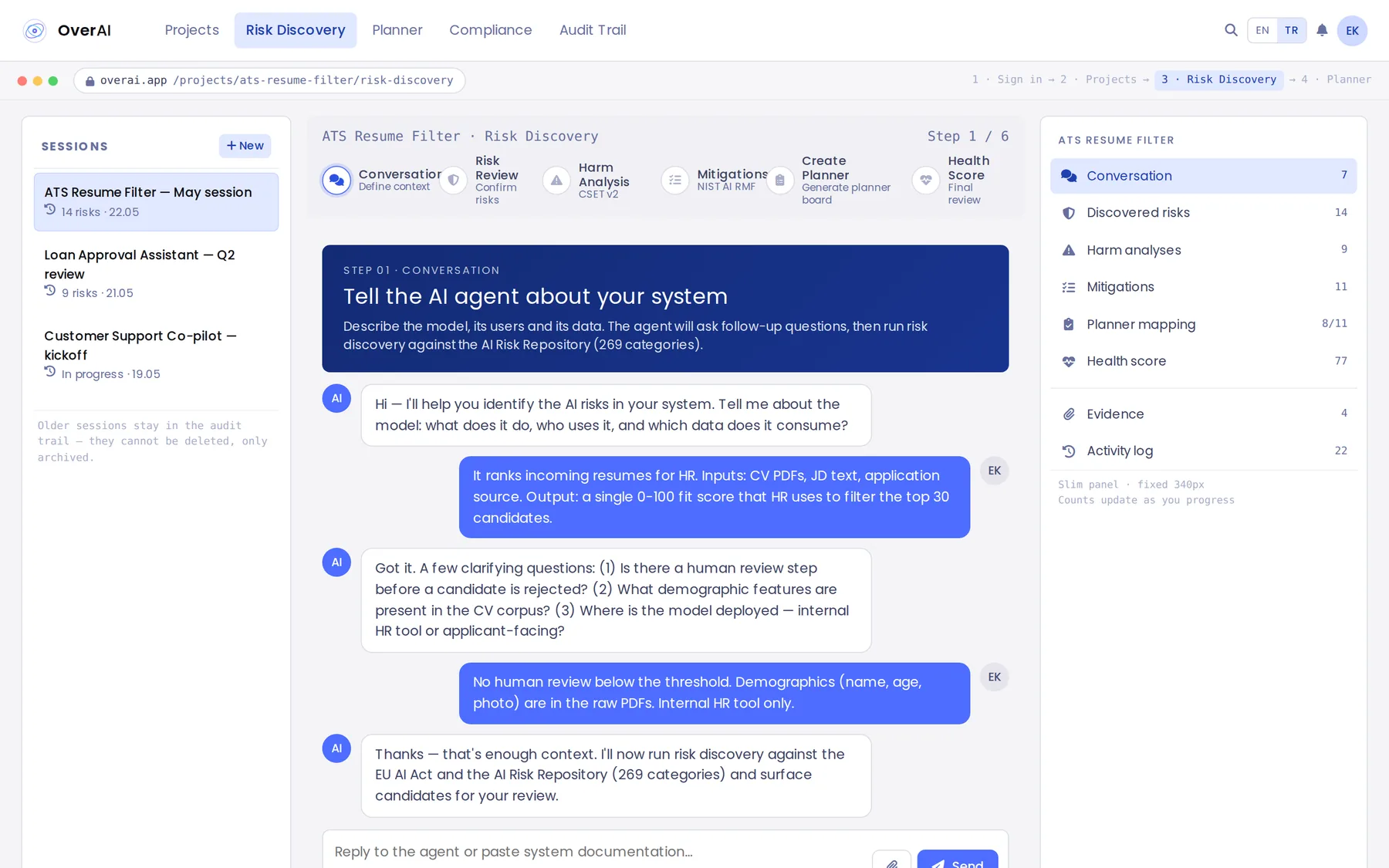
There is no form to learn. The agent asks what it needs, and every answer it collects stays attached to the record it produced.
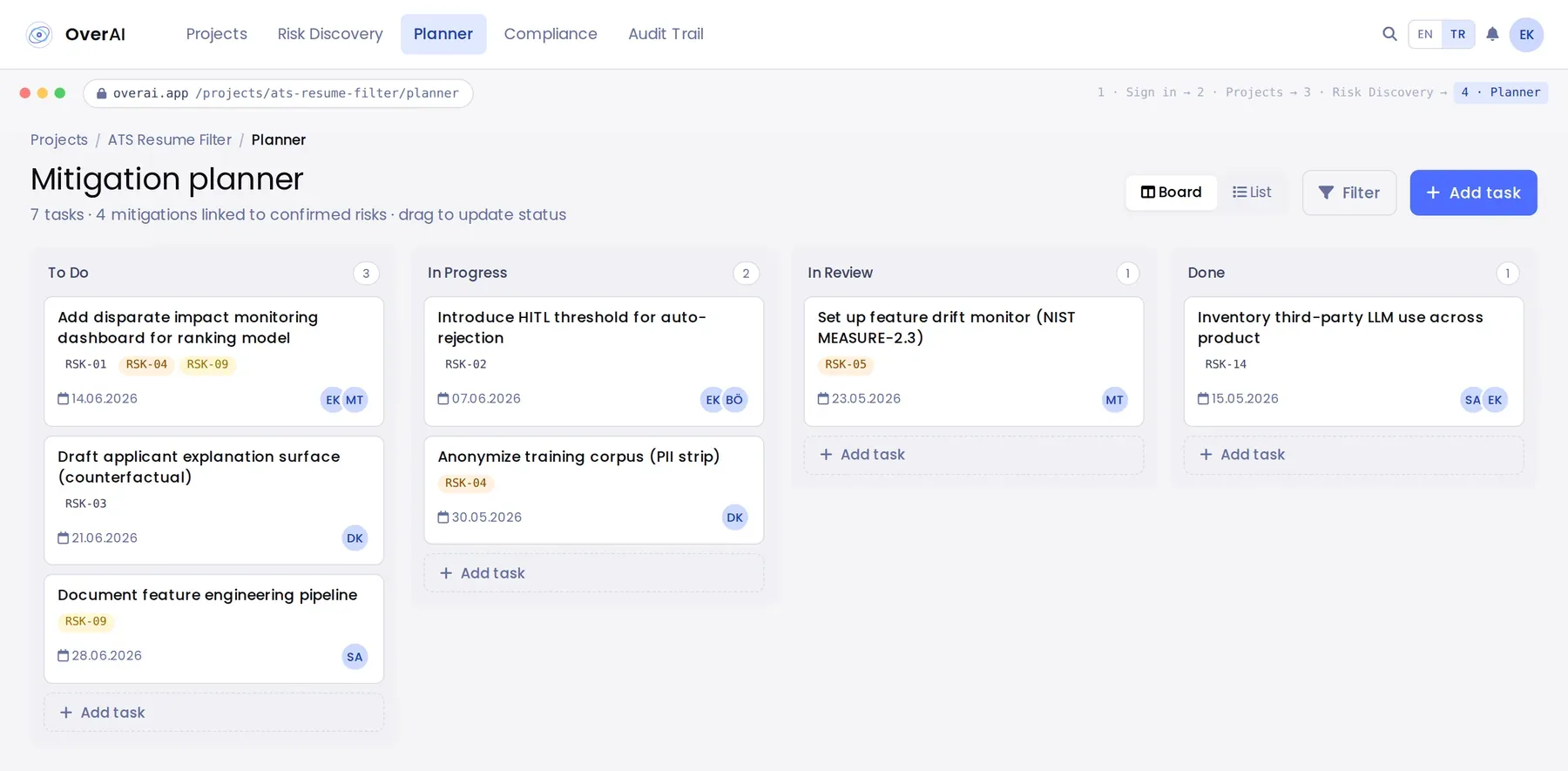
The Health Score is not a vanity number. It moves only as real controls are completed, which is what makes it worth showing to a board or an auditor.
Health Score = 100 − Σ(w × Risk score × (1 − Coverage)) / Σw
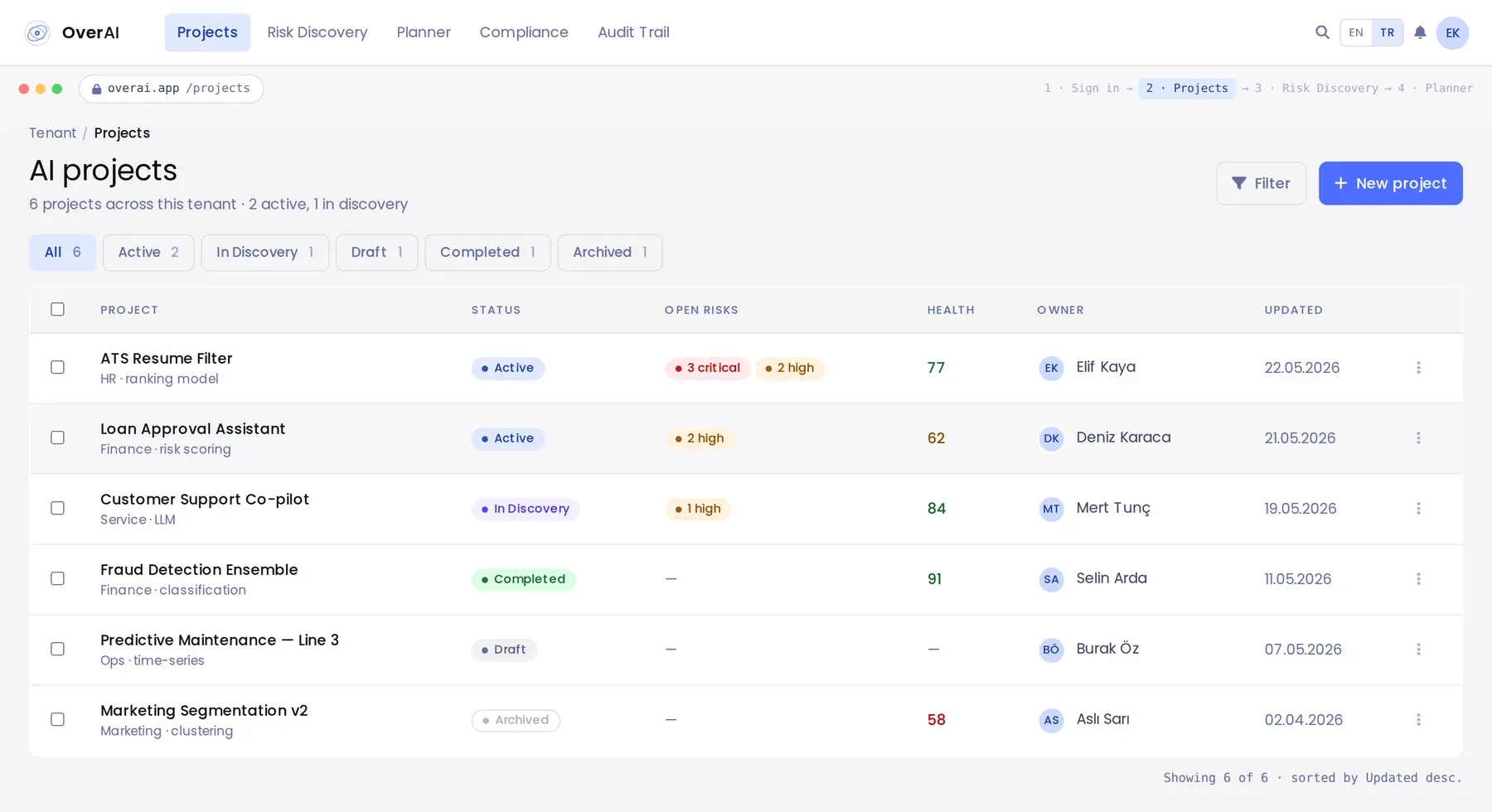
One project is a start. The portfolio view is what the board actually asks about, and it is built from the same numbers rather than assembled for the meeting.
Most tools either govern AI generically or perform AI tasks. OverAI grounds every result in authoritative, public standards, which is what makes the output defensible.
MIT AI Risk Repository, CSET harm taxonomy, NIST AI RMF and the MIT mitigation database.
Every risk is matched to documented cases in the AI Incident Database.
The core intellectual property is legal expertise expressed as a mapping algorithm.
A low-cost, flexible subscription rather than an expensive, rigid deployment.
A unified agentic platform covering risk discovery, harm identification, mitigation planning, task management and audit-ready reporting.
Capability
OverAI maps your AI systems to the obligations that apply and generates the evidence auditors ask for.
Continuous risk management, human oversight, transparency and technical documentation for high-risk AI.
Lawful processing, purpose limitation and the right to explanation for automated decisions.
An AI management system with defined roles, traceability and continual improvement.
Controls are drawn from a catalogue mapped to the NIST AI RMF, so every recommendation traces back to a published action.
Model risk management, explainable credit decisions and stress-test evidence, alongside standards such as BCBS 239 in banking.
Extensible to national data-protection regimes, including Turkey's KVKK. Consent, access and objection rights are modelled as requirements like any other.
How we help you comply
OverAI applies across regulated industries: telecom, banking, healthcare, media and beyond.
Churn and credit or fraud scoring, generative customer assistants and network optimization, governed for fairness, privacy and explainability.
AI credit scoring and limit decisions, with bias testing and a human appeal path built in.
Diagnostic AI monitored for accuracy, sub-group fairness and human oversight.
Generative content with fact-checking, plagiarism and reputational controls.
Sample use cases and industries where OverAI can perform. The list is illustrative, not exhaustive.
Multi-tenancy, authorization and the audit trail are not features added later. They are defined in the data layer itself.
Every record is separated by tenant. Filtering is enforced at the data access layer, not left to business logic.
Eight roles and more than fifty permissions, with per-user grants and revocations supported.
Every insert, update and delete is recorded automatically with a before and after diff.
Installed with Docker. The database, object store and vector store stay in the environment you choose.
Interface, notifications and API messages in both languages, selected per user rather than per deployment.
Intake captures the personal data categories a system touches, and that answer stays attached to the risk records it produced.
For questions that need more technical detail, ask during the demo and we will walk through the chain on your own project.
Your project description is matched semantically against the subdomains of the MIT AI Risk Repository. Each matching subdomain becomes a risk. The harm type and the control that answers it come from rule tables, so the language model only performs the association.
The risk score is the product of an imminency coefficient, a harm-type coefficient and the project context coefficient. Context is the normalized average of the project's four context variables, which are derived from documented incidents rather than estimated. The result falls into five fixed bands: 76 and above is critical, 51 high, 26 medium, 11 low, and below that negligible.
No risk proceeds without human approval. Records that do not match the taxonomy are marked as awaiting classification and no severity band is shown for them. A rejected risk keeps its number, which is never reused, so the numbering in an older report stays valid.
Harm classification follows CSET and control labels follow the NIST AI RMF functions. EU AI Act, ISO/IEC 42001 and GDPR requirements are met on the documentation and audit-trail side. Further frameworks are defined in the data model and are being enabled in turn.
It runs on Docker Compose. The relational database, cache, message queue, object store and vector database are all included. For the language model you can use your own API key or connect a local model.
The application and the data layer run in the environment you choose. The only traffic that leaves it is the calls to the language model provider you configure. With a local model even that connection disappears.
Yes. The scoring chain is table-driven, so it can be adapted to a bespoke enterprise framework or aligned with ISO 31000 without changing how the evidence is produced.
Bring one AI system and we will take it end to end, from the first conversation to a Health Score, with your own data and your own sector context.